Load01Muscles02Reaction03Formulas04Research05Your data06Pricing07FAQ08Get the beta, free

KovuraThe strength log that knows what’s recovered.

Latest additions to the betaTestFlight
  1. Nov 14NewCheck-in, one card at a time, with a stamped score at the end
  2. Nov 14NewEstimated 1RM from your own sets, guesses clearly labelled
  3. Nov 14ImprovedHRV scan warns you when it's past late morning
  4. Nov 5NewRecovery forecast: drag the map through the next 72 hours
  5. Nov 5NewPick your check-in reminder time
  6. Nov 4FixedTraining split chart labels no longer overlap
  7. Nov 4ImprovedHRV scan shows where to put your finger
  8. Oct 29NewApple Watch app and an interactive muscle-map widget

Kovura is a workout logger for iPhone. Log sets, reps and RPE in seconds, and it works out per-muscle recovery and training load as two separate numbers, so one never hides the other. It works without a watch or an account, and your data stays on your phone unless you turn on iCloud.

Two numbers. Never averaged.

Readiness looks forward: can your body train today? Load looks back: how hard have you trained lately? Pick a day and watch each one answer on its own, with the real math underneath.

Demo data
ReadinessLooking forward
72
READY TO TRAIN
4070
HRV vs your normal56
Resting HR vs your normal54
Sleep, 7.75 h88
Whole-body recovery70
Muscles you train, average74
0.5 × 70 + 0.5 × 74 = 72
LoadLooking back
0.92
LOW RISK
0.81.31.5
Today's session load0
7-day average207
28-day average225
207 ÷ 225 = 0.92
Two numbers. Never averaged together.Every formula

Simulate a set. Watch both numbers move.

This is the app's workout logger. Pick an RPE, tick the box, and the rest timer starts, the Live Activity on your Lock Screen and Dynamic Island moves, and the set's effort lands on the muscles it works. Readiness drops and today's Load climbs, each on its own.

0:00
LEG DAY0%
0:00
9:41
LEG DAY
00:00
Kovura app icon
Tuesday, November 17
9:41
LEG DAY0:00
0%
Readiness72READY TO TRAINmuscles you train: 74
Load ratio——today: 0 (sets × RPE)
No sets logged yet. Effort = RPE × the exercise's split.
Recovered, under 0.2A bit sore, 0.2–0.5Very sore, 0.5+

Drag your load into the red.

Set your 7-day and 28-day average daily load. The curve shows where the ratio goes if you keep training at this week's level, using the same exponential averages the app uses.

430
Average per day, session rating × minutes.
270
Ratio1.07
Injury riskLOW
Build a whole training month
Ratio if you hold this week's load0.8–1.3 sweet spot · 1.3–1.5 caution · 1.5+ high

Tap a muscle. Train it. Tell it you're sore.

The app's own body map, 17 regions. Log a workout and its fatigue decays on that muscle's recovery clock. Check in at 4 out of 5 sore and your answer wins for the day, while its clock learns to run slower.

Tap a muscleRight after
0 h
RecoveredA bit soreVery soreNot trained
Quadsτ 31 h
Readiness80
StatusNOT TRAINED
Back to 70+—

Pick a muscle, then log a workout: 4 sets at RPE 8 of its main exercise.

8 engines. Flip any card for its math.

Every number in Kovura comes from a deterministic engine on your phone, built on published sports science. The on-device AI only explains what these produce.

ACWR.swift

Acute:chronic workload

1.07ratio, live from the sandbox above

A fast 7-day average of daily load against a slow 28-day one. Above 1.5, injury risk reads high.

ACWR.swift
λ = 2 ÷ (N + 1), N = 7 and 28
acute = load·λ₇ + acute·(1 − λ₇)
ratio = acute ÷ max(chronic, 0.3 × peak)

Gabbett 2016 · Murray 2017
ACWR.swift

Session RPE

7 × 60 = 420rating × minutes

Each finished workout counts as your 0–10 session rating times its minutes. No wearable required.

ACWR.swift · StrainMethod
day load = rating × minutes
before your first finished workout:
day load = Σ set RPE

Foster 2001 · Borg 1982

MuscleReadinessEngine.swift

Fitness-fatigue, per muscle

17 regions, each with fatigue fading over about a day and fitness over about ten.

Muscle map
MuscleReadinessEngine.swift
fatigue = Σ load × e^(−t ÷ τ), τ 25–34 h
fitness = Σ load × e^(−t ÷ 240 h)
readiness = 80 + 20·fit/90 − 100·fat/35

Banister 1975 · Busso 2003

RecoveryEngine.swift

HRV and resting heart rate

Read from Apple Health and scored only against your own last 14 days, never a population.

RecoveryEngine.swift
score = 50 + 20 × z (z vs your 14 days)
weights: HRV 0.45 · RHR 0.30 · sleep 0.30
HRV needs 7 earlier readings

Plews 2013 · Buchheit 2014

PPGProcessor.swiftBeta

Camera HRV scan

rMSSD, simulated—

A 60-second fingertip scan over the camera and flash for days without watch HRV. Opt-in, free.

PPGProcessor.swift
10 s to settle, 60 s measured
band-pass 0.7–3.5 Hz → beats
rMSSD = √ mean(Δ interval²)
over 10% beats dropped → redo

Plews 2017

ReactionTimeCheckView.swift

CNS reaction test

Tap the instant it flashes. This mini version is 3 rounds; the app uses 5 and keeps the median.

ReactionTimeCheckView.swift
result = median of 5 taps
wait 0.8–2.0 s, random
score = 50 − 20 × z (slower scores lower)

Dinges 1985 · Basner 2011

ACWR.swift

Training variety

Seven identical days are a warning sign on their own, so Kovura shows how varied your week was.

ACWR.swift
monotony = 7-day mean ÷ SD
variety = 100 ÷ monotony
50 at Foster's 2.0 line

Foster 1998

SleepRecoveryEngine.swiftBeta

Sleep-adjusted recovery

5 h → 83%clock speed vs a 7.5 h normal

A short night runs every muscle's recovery clock a little slower. Small on purpose, and capped.

SleepRecoveryEngine.swift
ratio = last night ÷ 14-day average
speed = 1 + k × (ratio − 1)
held to 0.8–1.1, k learned from check-ins

Lamon 2021

The app itself, as it ships in the beta.

Log a set in two taps, check in once a day, and read every muscle at a glance. 209 catalog exercises, 17 muscle regions.

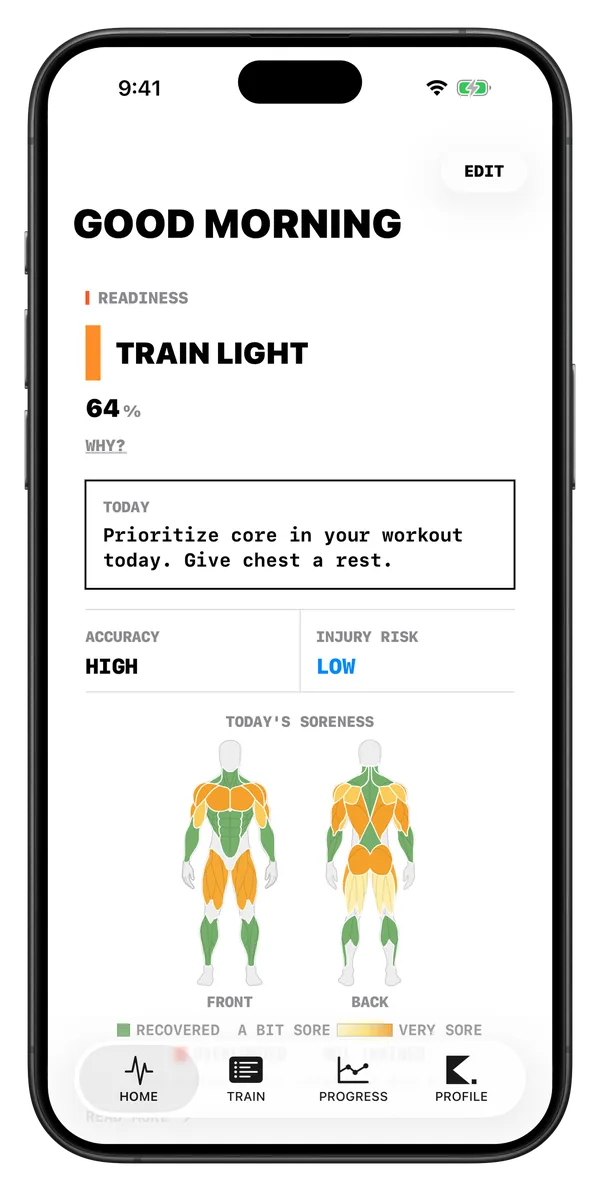
Kovura's Home screen: readiness Train Light at 64%, today's advice, injury risk low, and a front and back body map of today's soreness.
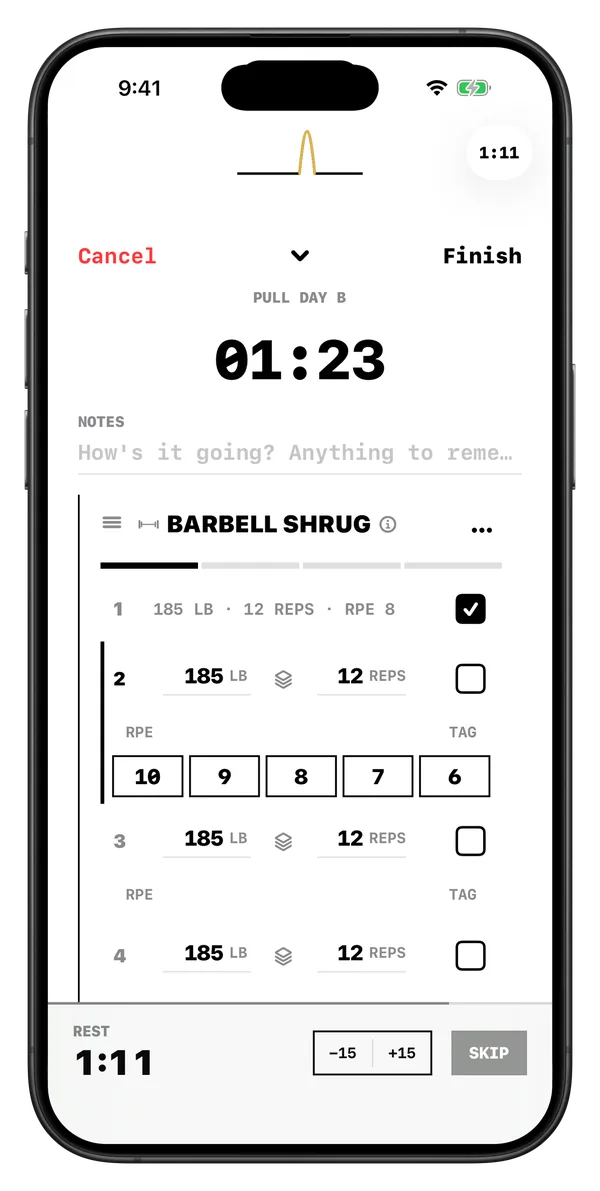
Kovura logging a workout: a barbell shrug set of 185 lb for 12 reps at RPE 8 checked off, the RPE picker open for the next set, and a rest timer running.
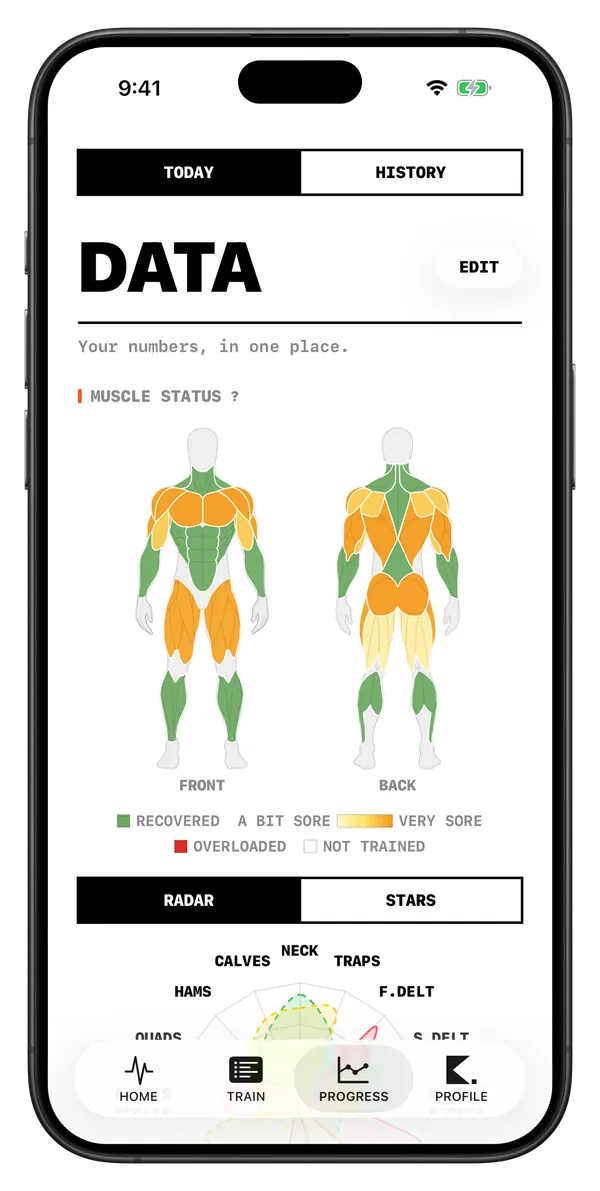
Kovura's muscle map coloured from recovered green to very sore orange, with a legend for overloaded and not trained.
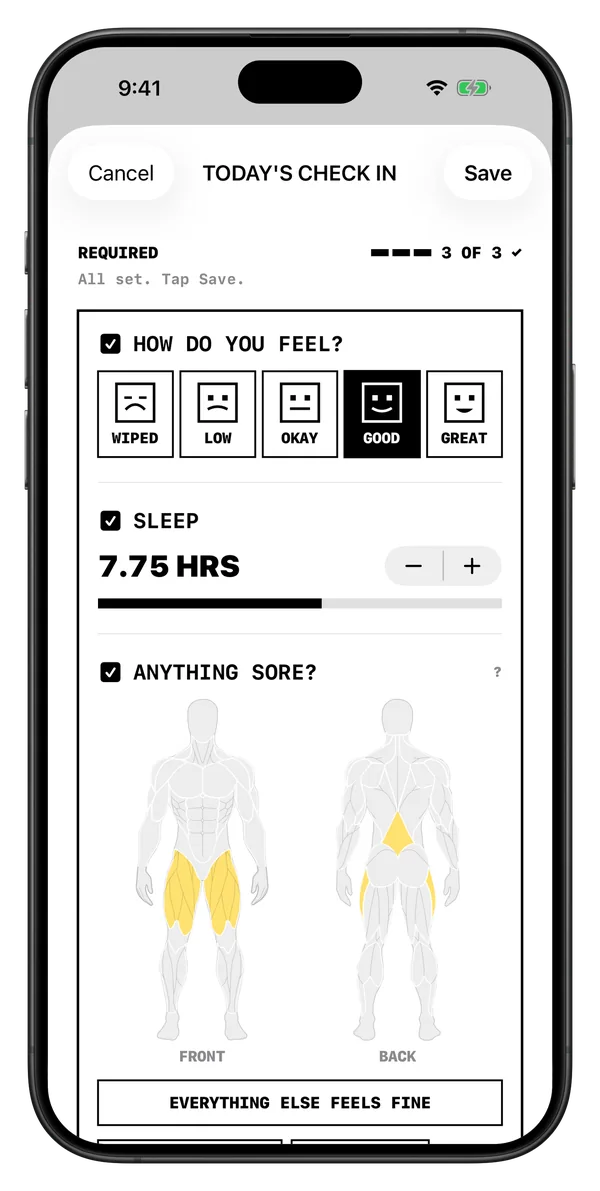
Kovura's daily check-in: feeling good, 7.75 hours of sleep, and sore quads and lower back tapped on the body map.

Your training data stays yours.

There is no Kovura account and no Kovura server. Sync, backup and export run through things you already own: your iPhone, your iCloud, your files.

Default

On your iPhone

Kovura starts in Local Only mode. Every score is computed on the phone, from data stored on the phone.

Opt-in

iCloud Backup

Turn it on in Settings, Data & Backup. It syncs through your own private iCloud with Apple's CloudKit and restores on a new iPhone with the same Apple ID.

Premium, free in beta

Export everything

One backup file with every workout, routine, recovery entry, body metric and setting, plus a CSV with one row per logged set.

With permission

Apple Health

Reads HRV, resting heart rate, sleep and VO₂ max, and writes back only the workouts you finish in Kovura.

How your data is stored

Get the beta, free.

Kovura is in open beta on TestFlight for iPhone. It's free to download. Beta testers keep Premium free for good. After launch, Premium is $4.99 a month or $34.99 a year, with a 7-day free trial on the annual plan.